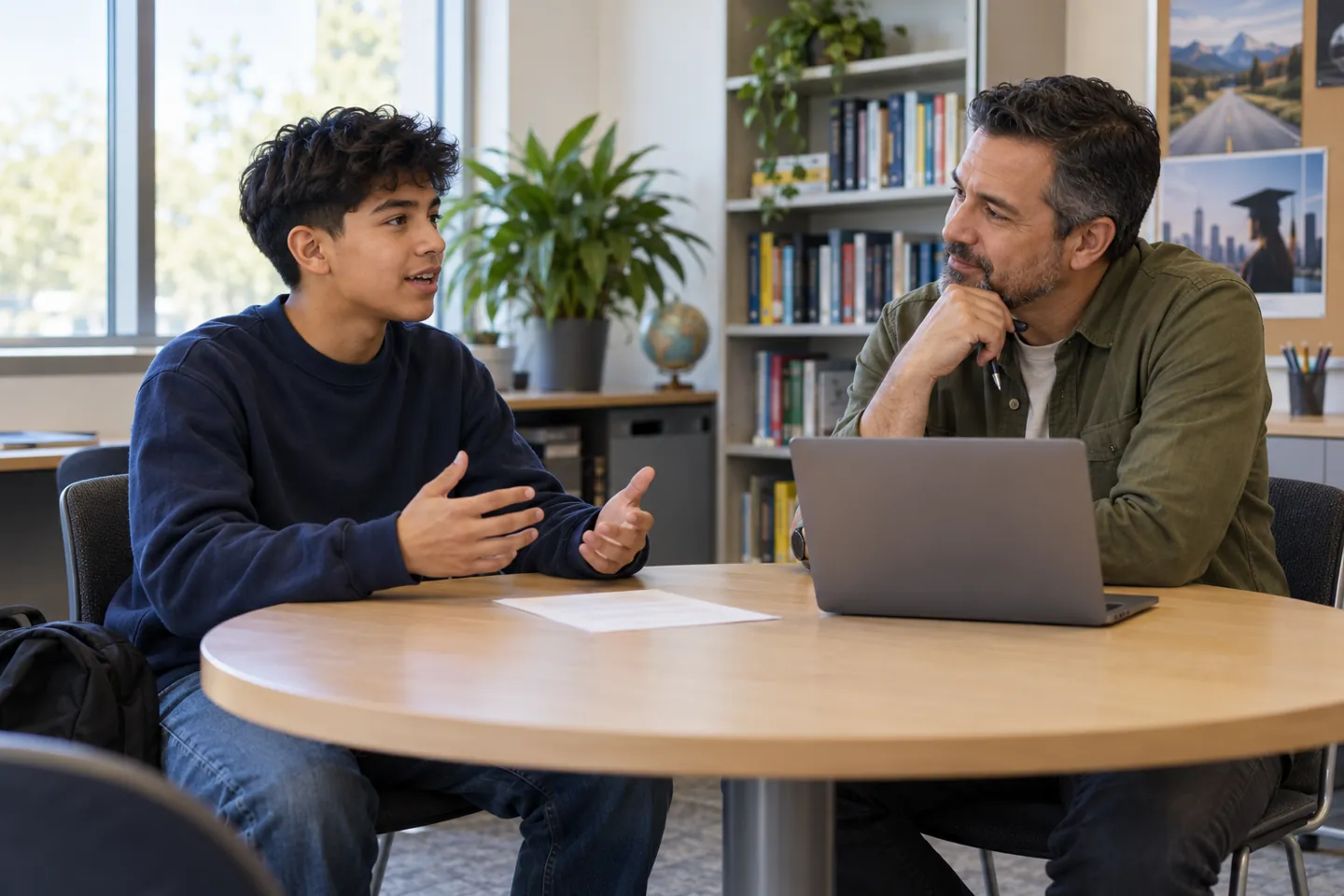
A mentor introduction can help a student meet someone who can answer a college or career question. Start with a trusted adult you already know. Explain what you want to learn, ask whether they know a suitable contact, and request permission before anyone shares contact details. Then prepare a short conversation with support that fits your age.
Quick answer: Ask for one connection around one clear question. In fact, you do not need a large network or a polished career plan. A counselor, teacher, caregiver, coach, or established mentor may help you find an appropriate next contact.
MENTOR recognizes January as National Mentoring Month. This December guide helps you prepare ahead of that month. Canyon’s closing exercise turns your curiosity into an original request you can adapt.
Our career conversation starters can help you name your question. Calendar publication date: December 13, 2024. Guidance reviewed October 10, 2026.
Choose one question before asking for a mentor introduction
First, decide what you want to understand. “Help me with my future” gives an adult little direction. “I want to learn how someone uses design skills at work” suggests a useful conversation.
Next, connect the question to something you already do. You might enjoy fixing a bicycle, organizing an event, helping a sibling learn, making art, or playing a team sport. For example, these interests can offer a starting point.
Also, keep the goal small enough for one conversation. Try asking about a typical task, a learning pathway, or support available at a college. You can change your question as you learn.
CareerOneStop describes informational interviews as research conversations about a career or company. Therefore, that can be the purpose of your request. You are asking to learn rather than expecting a job or admission offer.
Finally, write your question in your own words. Our career curiosity journal offers a place to save it without choosing a lifelong career.
Start with a trusted adult you already know
Next, think about people who already know you in a suitable role. A teacher may understand your interests. A school counselor may know the right office. A coach or caregiver may help identify a verified contact.
A trusted adult does not have to know a famous person. A local professional, program representative, or recent graduate may offer useful insight into one question.
The College Board’s counselor resources include questions about education and career options. You can bring your own question to a school conversation, even if you are still exploring.
Also, let the adult say what they can realistically do. They may suggest a resource instead of an introduction. However, that answer can still move your research forward.
Finally, avoid ranking people by how impressive their contacts seem. Choose the person who understands your question and can help plan an appropriate connection. Our family conversation guide supports that student-led discussion.
Match your question to the right kind of contact
Use this original table to narrow the request. The best contact depends on what you need to learn. In other words, one person does not have to answer every college or career question.
| Your question | A possible contact | A focused request |
|---|---|---|
| What is the daily work like? | A professional in that role | A brief conversation about one typical task |
| What does this program require? | The program’s official office | Clarification of a current published requirement |
| How can I explore an interest now? | A teacher or school counselor | One class, activity, or research suggestion |
| What support does this campus offer? | The relevant campus support office | Information about its services and access process |
Next, separate experience from official rules. A graduate can describe their own experience. The institution should confirm current requirements.
Oregon State University’s informational interview guidance describes conversations with people who can offer insight into a position or career. Our campus support comparison guide can help with a different kind of research question.

Write a mentor introduction request in four parts
First, say what interests you. Next, name what you want to learn. Then ask whether the adult knows an appropriate contact. Finally, give them room to decline or suggest another route.
You can adapt this original mentor introduction message:
Hello [name], I am curious about [field, program, or role]. I would like to understand [one question]. Do you know someone who might be willing to answer it in a short conversation? If so, could you first check whether they are comfortable with an introduction? I can prepare a few questions and follow the school or program’s process. If not, a resource suggestion would also help. Thank you.
Also, avoid sending a long life story with the first request. A short explanation makes your purpose easier to understand. You can share relevant context later if you choose.
For a college question, the College Board’s counselor tools may help you refine what to ask. Our New Year planning reset can help you choose a single priority.
Finally, read the draft aloud. Does it sound like you? Keep the request polite and direct rather than adding words you would never use.
Agree on permission and practical details
Before an introduction happens, agree on what the adult may share. A first name and a short learning question may be enough. You do not need to include a home address, private records, or account credentials.
Next, ask the adult to check the other person’s willingness first. After all, a connection works better when both people understand the purpose. Avoid passing someone’s private contact details around without their permission.
For a student under 18, involve a caregiver, school contact, or established program coordinator in the arrangements. Use the school or program’s approved communication channel when one applies.
Also, confirm who will join the conversation, the format, the time, and the meeting place. Ask the responsible adult what arrangements fit your age and situation. Follow any school or program rules.
Finally, a brief introduction is different from joining an ongoing mentoring program. MENTOR’s National Mentoring Month resources offer a broader mentoring context. Our job-shadow preparation guide covers another activity that needs its own planning.
Prepare for the conversation after a mentor introduction
First, read a little about the role or program. Use an official page where possible. Then, write down the source so you can distinguish published information from someone’s personal experience.
Next, choose three questions that invite examples. You might ask, “Which task uses this skill most often?” or “What would you suggest a student explore first?” For a college office, ask about the specific service or requirement you need to understand.
CareerOneStop’s informational interview guidance frames the conversation as a chance to learn from someone’s experience. Use that focus to keep your questions relevant.
Also, agree on the length before the conversation. Start on time and ask whether note-taking is welcome. Ask separately before making an audio or video recording.
Finally, leave with one new fact and one next question. You do not need to turn the conversation into an immediate decision. Our student question guide can help you practice aloud beforehand.
Follow up with thanks and one specific takeaway
Afterward, thank the person who spoke with you and the adult who helped connect you. Mention one useful idea rather than sending a generic message.
For example, you could write: “Thank you for explaining how you plan a project before starting the design. I am going to try that approach in my next class project.” This is an original message you can adapt.
Next, save a brief note about what you learned. Also, mark any detail that still needs an official source. One person’s path does not establish every training requirement in a field.
Also, ask permission if you want to contact the person again. A helpful first conversation does not create an obligation for ongoing mentoring.
Finally, choose a follow-up task that fits your life. Our learning-path comparison guide can help organize further questions. Oregon State’s career conversation resource offers another reference as you continue exploring.

If the answer is no, choose another route
A declined mentor introduction does not tell you whether your interest is worthwhile. The adult may not know a suitable person, or the contact may lack time.
Next, ask whether they can suggest an official resource or a school-approved opportunity. You can learn something useful while waiting for another connection.
If no one responds, consider winter closures and the person’s stated availability. Agree on a reasonable follow-up with your supporting adult. Avoid sending repeated messages through several channels.
Also, start with a counselor or teacher if you do not have an established mentor. The College Board’s counselor resource page offers prompts for that conversation. You do not need a formal mentoring relationship to ask a learning question.
Finally, keep your original question visible. Our three-task planning reset can turn the next research step into something manageable.
Try Canyon’s question, connection, next-step exercise
This original Canyon exercise helps you compare possible learning paths through one focused request. For example, use a plain page, a note on your device, or a conversation with a trusted adult.
- Question: Write one thing you want to understand about a college or career path.
- Connection: Name a trusted adult and the kind of contact who could help.
- Permission: Agree on what to share and how to arrange the conversation.
- Next step: Draft your request, then decide when to review it together.
For example, a fictional student named Jordan enjoys organizing school events. Jordan asks a teacher about a conversation with an event coordinator to learn how planning skills work in that job.
Next, Jordan prepares three questions and lets the teacher check the contact’s willingness. In this example, the goal is a learning conversation. No placement, job, or continuing mentorship is promised.
Your next step: Save this mentor introduction guide and draft one request in your own words. Explore iLevelUP’s student resources for related planning tools. Then use the curiosity journal to record what you learn.
Mentor introduction: FAQs for students and families
What is a mentor introduction?
It is a connection through a trusted adult to someone who may help answer a learning question. It can lead to a conversation without creating an ongoing mentoring relationship. CareerOneStop explains informational interviews as career research. Our conversation starters help you choose a question.
How can I ask without sounding demanding?
State your interest, ask one specific question, and give the adult room to decline. For example, use the original request above as a starting point. Our supportive-adult guide helps keep your voice central. College Board’s counselor resources can help you refine a college question.
What if I do not have a mentor?
Start with a counselor, teacher, caregiver, or another trusted adult in an appropriate role. Ask about a resource or verified contact. College Board offers counselor conversation tools. Our planning reset can help you define the support you need.
Is National Mentoring Month in December?
No. MENTOR identifies January as National Mentoring Month. This December calendar entry helps students prepare ahead of it. You can ask a learning question throughout the year. Our curiosity journal can help you begin with an interest.
What should I share with a new contact?
Share your learning question and only the context needed for that conversation. Agree on details with your supporting adult first. Our visit preparation guide covers practical planning for another activity. Oregon State’s informational interview resource explains the career-conversation format.
Does an introduction guarantee a job or ongoing mentor?
No. Instead, treat it as an opportunity to learn if the contact agrees. CareerOneStop describes an informational interview as a research conversation. Our pathway comparison guide can support further research without promising a particular outcome.
Sources and editorial notes: Reviewed October 10, 2026. MENTOR, College Board, CareerOneStop, and Oregon State University guidance is linked throughout. The request script, contact table, Canyon exercise, follow-up example, and fictional Jordan story are original editorial tools. Introductions depend on willingness and appropriate arrangements; no job, placement, or ongoing mentorship is promised. Images are original AI-generated editorial illustrations.