

College essay word count matters because your response must fit the limit shown in the application. To shorten a draft, keep the main experience, your choices, and what you learned. First, cut repeated ideas and extra setup. Then tighten sentences and check the result in the actual application field.
Quick answer: If you are deciding what to cut, remove details that do not help answer the prompt or show your perspective. Keep the evidence that makes the story yours. A shorter essay should still explain what happened, what you did, and why it matters.
This guide gives students and first-generation families a practical editing order, three original examples, and a Taiga revision challenge. Use our weekly planning routine to set aside one focused editing session.
Calendar publication date: September 27, 2024. Guidance reviewed October 9, 2026. Check the current prompt and limit for your application cycle.
Check your college essay word count limit first
Before editing, copy the exact prompt and length rule into your draft notes. Check whether the field measures words or characters. Also, note any minimum as well as the maximum.
For the Common App personal essay, Michigan’s official essay guidance currently lists a range of 250 to 650 words. That range does not apply to every college response. Supplements, short answers, and other fields can have their own limits.
For example, Yale’s essay page includes both word-limited responses and character-limited short takes. Read the rule for the specific box you are completing. Do not assume that a document’s page length tells you whether the response fits.
Next, add the prompt, current count, and required limit to your application tracker. Our 30-day application calendar can help you leave time for this final check.
Protect the meaning before reducing college essay word count
First, write one sentence for yourself: “This essay shows how I [acted, changed, or understood something].” That sentence gives you a way to judge each paragraph. It does not need to appear in the submitted essay.
Then mark three kinds of evidence to keep:
- A specific moment that helps the reader understand the situation.
- Your action, choice, question, or response.
- Your reflection on what changed or what you now understand.
A draft about helping a sibling with homework might show how you changed your explanation after the first attempt failed. The useful detail is the adjustment you made. Several sentences listing every book on the table may add little to that point.
Also, avoid cutting all the reflection just because action feels easier to describe. Your reader needs to understand your perspective. Yale’s writing advice emphasizes meaningful topics and the applicant’s own voice. For everyday experiences, try our guide to work and family responsibilities.
Cut repeated ideas before cutting individual words
If you are well over the limit, start with paragraphs and ideas. Removing one repeated point can help more than changing many tiny phrases.
First, label each paragraph in a few words. For example: “the problem,” “my first attempt,” “the change,” and “what I learned.” If two paragraphs have the same job, ask whether both add distinct evidence.
Next, look for repeated lessons. You may explain that you learned patience in the opening, middle, and ending. Keep the strongest explanation and use the space for a concrete moment instead.
Then check the setup. Does the reader need the full history of the club, job, or project? Keep enough context to understand your part. Save a deleted passage in a separate file if you are unsure. That way, you can compare versions without losing work.
Finally, check that every remaining paragraph helps answer the actual prompt. A strong paragraph can still belong in another response.

Lower college essay word count with clear sentences
Once the structure works, read each sentence for extra words. For example, “I made the decision to ask” can often become “I asked.” Keep the change only if it preserves your meaning and sounds like you.
Remove repeated pairs such as “worked together as a team” when “worked as a team” says enough. Also, check vague intensifiers such as “very” and “really.” A useful detail may do more than an extra adjective.
For general practice, Purdue OWL’s concision guide explains how specific words and careful sentence choices can improve clarity. Concision is about making words useful, rather than making every sentence as short as possible.
Then read the revision aloud. If a sentence sounds stiff, try a simpler version. Do not replace familiar language with a word you would struggle to explain. Your essay should sound like a thoughtful version of you.
College essay word count examples: what stays and what goes
These are original practice sentences, not excerpts from real applicants. Counts below use words separated by spaces. Your application’s counter remains the final check.
| Before | After | Count change |
|---|---|---|
| During the time that I worked at the grocery store, I was able to learn how to stay calm when customers were upset. | I learned to stay calm with upset grocery store customers. | 23 to 10 words |
| At that point in time, I made the decision to ask my coach for help because I did not understand the new routine. | I asked my coach for help with the new routine. | 23 to 10 words |
| I was very proud of the fact that our group worked together as a team to finish the garden project. | I felt proud when our team finished the garden. | 20 to 9 words |
The first edit keeps the learning point while removing extra setup. The second keeps the request for help. The third removes a repeated teamwork phrase.
However, the shorter version is not automatically the best essay sentence. You may need one more detail to show the moment. For example, a student could explain how they helped an upset customer or what the coach clarified. Add that detail only if it is true and supports the essay’s purpose.
Do not copy these sentences as your personal experience. Instead, try the same editing questions on your own draft.
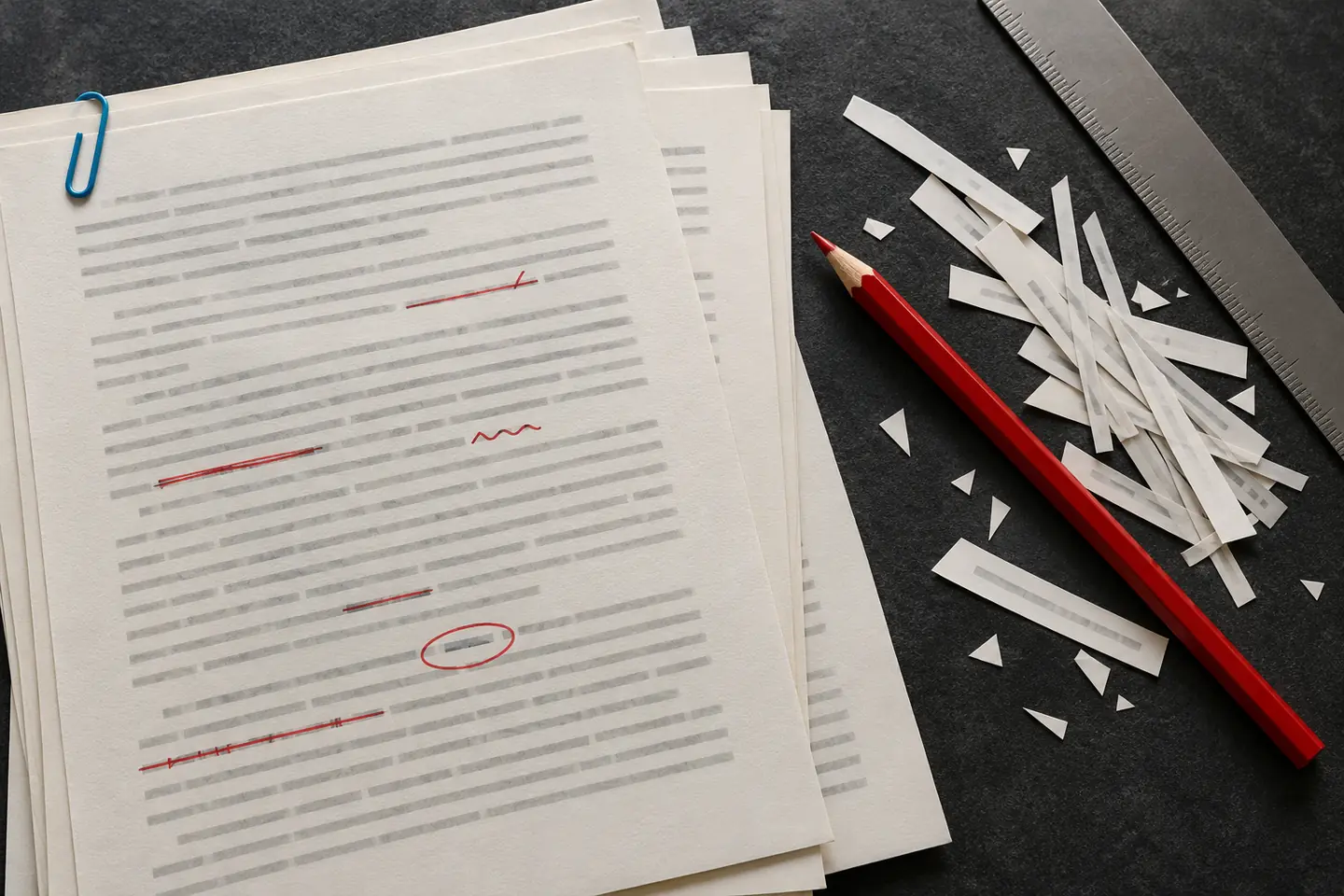
Keep feedback useful and keep the voice yours
Ask a trusted reader two focused questions: “Where do I repeat myself?” and “What detail would you miss if I removed it?” Those questions help you make choices without handing over the writing.
Also, tell the reader what kind of help you want. You might ask for unclear passages and spelling errors, while keeping your own phrasing. Then decide which suggestions fit your story.
Check each college’s AI policy before using a tool. For example, Yale’s AI policy distinguishes limited grammar or spelling review from submitting substantive AI-generated writing. That is Yale’s policy; another college may state different rules.
If you use a permitted proofreading tool, review every change yourself. Avoid sharing private family details or personal identifiers just to get editing help. Our ethical AI college-prep guide can help you think through the role of tools.
Finally, never add an achievement, quote, or experience because it makes a shorter draft sound stronger. Accuracy belongs in every version.
Check college essay word count in the application
After you finish editing, keep a clean copy with a clear filename. Next, place the response in the correct application field and check the count shown there.
Read the pasted version from beginning to end. Confirm that the ending is complete and that paragraph breaks, punctuation, and any special characters appear correctly. Also, make sure you did not paste a college-specific response into another college’s box.
If the counter differs from your document, follow the field’s displayed limit. Recheck after every last-minute edit. Do not try to hide extra words with odd spacing, symbols, or a separate attachment unless the college specifically permits it.
Use the Common App first-year guide to review college-specific writing requirements and the application process. Then save a preview or final copy as your record. Our submission checklist can help you keep that task visible.
Taiga challenge: test one cut before making ten
Taiga’s exploration challenge asks you to try a small change, observe the result, and explain your choice. Apply that curiosity to revision instead of deleting words at random.
- Choose one paragraph from your own draft.
- Write its main job in one short sentence.
- Mark one repeated idea or extra setup phrase.
- Make a copy and remove that part.
- Read both versions aloud.
- Keep the edit only if the paragraph still does its job.
For example, you might discover that removing a long introduction makes your main action easier to find. Or you may realize that a small detail matters more than you expected. Both results teach you something about the draft.
Next, share the two versions with a trusted reader and ask what changed. Use iLevelUP’s student resources to choose another Taiga exploration step. A useful revision goal is a clear, honest response that fits the required space.
College essay word count FAQs
Michigan’s official guidance currently lists 250 to 650 words for the Common App personal essay. Check your live application field and cycle. Other responses have their own rules. Use our application calendar to schedule the final count check.
No. Meet any minimum and stay within the maximum, while giving enough detail to answer the prompt. Michigan describes 650 words as a limit rather than a target. Use our planning routine to leave time for a clarity review.
Start with repeated ideas, extra background, and sentences that do not support the prompt. Then tighten phrasing without losing meaning. Purdue OWL offers general concision practice. For everyday examples worth preserving, use our responsibilities guide.
Yes, ask for feedback while keeping control of your writing. Yale recommends sharing essays with trusted readers and retaining your own voice. The Taiga challenge above gives you two versions to discuss. Also, explore iLevelUP’s student resources for your next planning step.
Check the college’s policy first. Yale permits certain limited uses but treats substantive AI-generated application content as fraud. Keep authorship and editing decisions yours, and follow each school’s rules. Read our ethical AI guide before choosing a tool.
Follow the stated character limit and the field’s counter. Characters and words measure different things. Yale’s essay instructions show examples of both types. Add the correct unit to your tracker, using our weekly planning guide to organize the check.
Source review: Common App, University of Michigan, Yale, and Purdue OWL guidance, checked October 9, 2026. The editing examples and Taiga challenge are original practice tools. Images are AI-generated editorial illustrations.